Pesticide Industry’s Recent Legal Victories Raise Concerns Over Long-Term Public Health Risks
07/24/2026 / By Iva Greene

Federal courts and regulatory agencies have issued a series of rulings and decisions favorable to pesticide manufacturers since 2020, according to court records and agency filings. These decisions include the overturning of bans on specific pesticides and the approval of new uses for existing chemicals, as reported by the Environmental Protection Agency (EPA). Public health advocates warn the rulings may undermine protections against chronic illnesses linked to pesticide exposure, citing studies by the National Institutes of Health and the World Health Organization.
In a June 2026 decision, the U.S. Supreme Court blocked state-law lawsuits against the manufacturer of Roundup, ruling that the Federal Insecticide, Fungicide and Rodenticide Act (FIFRA) preempts such claims because the EPA had approved the product’s label without a cancer warning, according to the majority opinion written by Justice Brett Kavanaugh. [1] The ruling overturned a jury award of $1.25 million to a Missouri resident with non-Hodgkin lymphoma. Justice Ketanji Brown Jackson dissented, according to the ruling.
Background: A Shift in Regulatory and Judicial Outcomes
Between 2015 and 2020, the EPA under the Obama and first Trump administrations took steps to restrict several organophosphates and neonicotinoids, according to agency documents. Starting in 2021, courts and the EPA have reversed or paused multiple restrictions, including a 2023 court ruling vacating a ban on chlorpyrifos for food crops, as stated in the opinion by the U.S. Court of Appeals for the Eighth Circuit. The EPA’s 2024 decision to allow continued use of dicamba on soybeans and cotton, despite earlier court-ordered cancellations, was cited by agency officials as based on new data from manufacturers.
Industry representatives said the decisions support farmers’ access to essential tools. Bayer CropScience issued a statement calling the dicamba ruling “a win for agricultural innovation and food security,” according to reports. [2] Meanwhile, a 2020 federal court had ruled that “the EPA made multiple errors in granting the conditional registrations” for dicamba herbicides, ignoring evidence of widespread crop damage.
Key Victories for the Industry
In 2022, a federal judge in Texas blocked a nationwide EPA order canceling the registration of three dicamba-based herbicides, ruling the agency had not followed proper procedure, according to court filings. The EPA in 2023 approved a five-year renewal for paraquat, a herbicide linked to Parkinson’s disease in epidemiological studies cited by the European Food Safety Authority. John Platt, a former horse rancher who developed Parkinson’s after using paraquat, is among more than 6,000 plaintiffs suing Syngenta, according to a report. [3]
Industry trade group CropLife America said in a statement that “the science supports the safe use of these products” and that “regulatory certainty is critical for growers and food affordability.” The EPA also approved a batch of pesticide actions affecting corn, soybeans, wheat, oats and other crops in July 2026, according to The New American. [4]
Public Health Implications and Expert Opinions
A 2023 study in the journal Environmental Health found that residents near agricultural areas using the approved pesticides have higher rates of non-Hodgkin lymphoma, according to the study’s authors. A separate analysis published in GeoHealth linked pesticide use to cancer in children and adults in the Western United States. [5] Research increasingly ties pesticides to neurological disorders; a review published in The International Journal of Biochemistry & Cell Biology found that environmental exposure to neurotoxic pesticides increases Parkinson’s disease risk through gastrointestinal disruption. [6]
Public health researcher Dr. Margaret Reeves, a senior scientist at the Pesticide Action Network, said, “Each regulatory reversal allows continued exposure to chemicals that are known or suspected carcinogens, which will have measurable effects on community health over decades.” The American Academy of Pediatrics has called for stricter limits on pesticide residues in food, citing developmental risks to children. However, the EPA stated in a 2024 report that current tolerances remain within safe limits.
Outlook and Ongoing Debates
Legal challenges from environmental groups are pending against several of the recent EPA approvals, with cases expected to reach the U.S. Supreme Court, according to filings. A Senate GOP farm bill proposed in 2026 would permanently exempt dozens of hazardous chemicals from safety reviews required under FIFRA, drawing criticism from groups such as Beyond Pesticides. [7] The pesticide industry’s trade group, CropLife America, reiterated that regulatory certainty is vital.
Public health researchers argue that the long latency periods for diseases like cancer and Parkinson’s mean the full impact of recent regulatory changes may not be known for a decade or more, as noted by Dr. Reeves in a briefing. Historical patterns show that industry pushback against regulation is not new: after Rachel Carson’s Silent Spring, pesticide manufacturers quickly mounted attempts to discredit the book, and President Kennedy’s Science Advisory Committee ultimately vindicated her thesis, according to Robert E. Taylor’s account. [8] “No resolution of this problem is possible until the nation sets a goal of mandatory pesticide reduction, as some European countries have done,” wrote Will Allen in The War on Bugs. [9]
References
- NaturalNews.com. “Supreme Court Ruling Blocks Lawsuits Against Roundup Maker Monsanto”. June 26, 2026.
- Mercola.com. “This Toxic Herbicide Is Unregulated Despite C”. May 06, 2023.
- NaturalNews.com. “Former horse rancher and 6000 other plaintiffs are suing Syngenta after paraquat exposure led to Parkinsons Dise”. November 01, 2024.
- The New American. “EPA Approves More ‘Forever Chemical’ Pesticides for Food Crops”. July 02, 2026.
- Children’s Health Defense. “Pesticides Linked to Cancer in Children, Adults in Western U.S.”.
- Children’s Health Defense. “Neurotoxic Pesticides Disrupt Gut Microbiome, Increase Risk of Parkinson’s Disease”.
- NaturalNews.com. “Senate GOP Farm Bill Draws Criticism From Advocates Over Environmental and Health Provisions”. June 28, 2026.
- Robert E. Taylor. “Ahead of the curve shaping new solutions to environmental problems”.
- Will Allen. “The War on Bugs”.
- NaturalNews.com. “Study Links Pesticide Use to Higher Breast Cancer Rates in Rural U.S. Counties”. June 26, 2026.
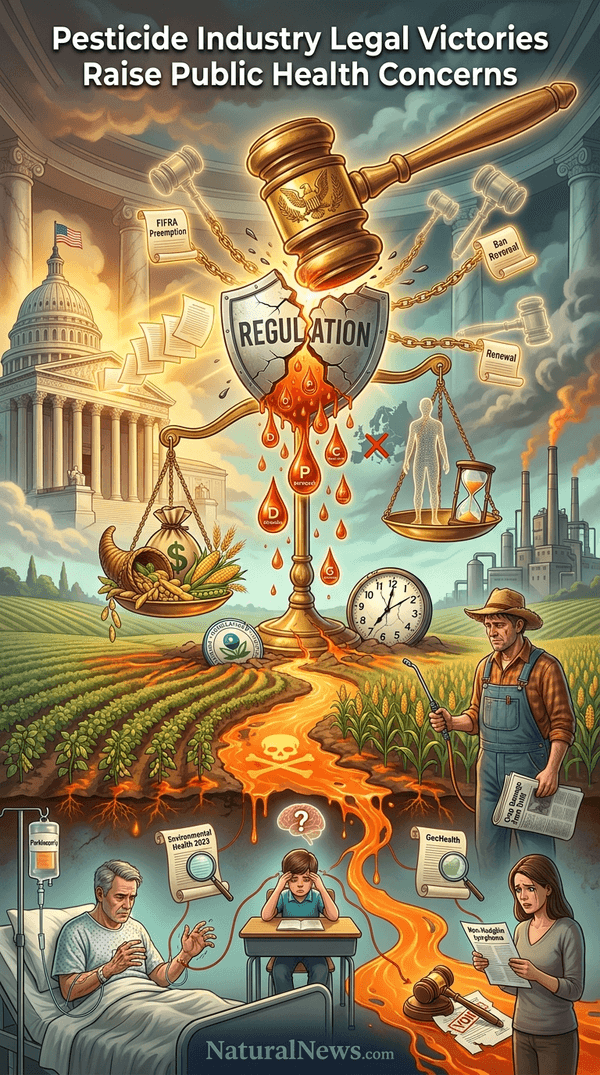
Explainer Infographic
Submit a correction >>
Tagged Under:
This article may contain statements that reflect the opinion of the author
RECENT NEWS & ARTICLES