Trump Memo Reduces Endangered Species Act Protections, The Hill Reports
09/20/2026 / By Iva Greene

President Donald Trump issued a memo directing federal agencies to reduce regulatory protections under the Endangered Species Act (ESA), according to The Hill.
The memo applies to the Department of the Interior (DOI) and the Department of Commerce (DOC), and was reported from Washington. It follows prior administration efforts to revise ESA rules.
According to The Hill, the memo instructs agencies to streamline consultation processes and limit critical habitat designations, a move the newsletter characterized as part of a broader deregulatory push in the energy and environment sector. The ESA, enacted in 1973, is administered chiefly by the U.S. Fish and Wildlife Service within the DOI and the National Oceanic and Atmospheric Administration Fisheries Service within the DOC [1].
Memo Details and Administration Rationale
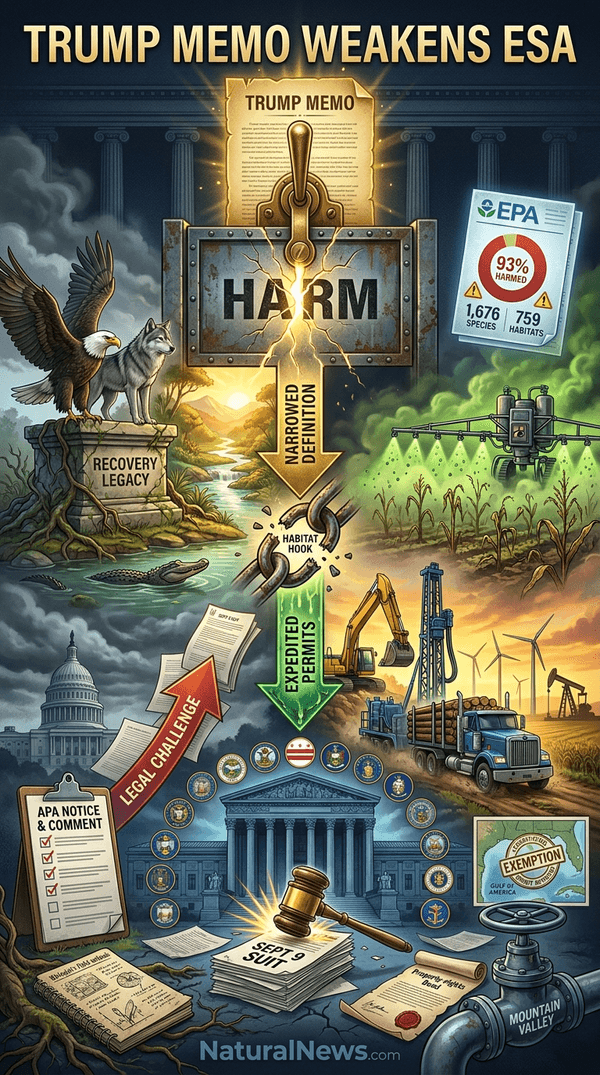
The memo directs agencies to revise ESA regulations and expedite permitting for energy and infrastructure projects, according to administration officials. The Trump administration has proposed narrowing the ESA’s definition of “harm” to endangered species, limiting it to actions that directly injure or kill the animals rather than including habitat destruction, a change that aims to reduce regulatory burdens [2].
Supporters say the move reduces regulatory burden and boosts domestic energy production while maintaining species protections where necessary, according to a statement from the DOI. The president has framed such actions as necessary to support what he described in his inauguration speech as an energy agenda: “We will drill, baby, drill” [3].
“The memo ensures environmental reviews are efficient and predictable,” an administration official said, according to The Hill. Related deregulatory actions include the repeal of the Obama administration’s Office of Surface Mining Stream Protection Rule, which Trump said would save “many thousands of American jobs, especially in the mines” [4].
Environmental Groups and Democratic Lawmakers Respond
Opponents say the memo undermines science-based protections and could accelerate species decline, according to statements from environmental organizations. The Center for Biological Diversity has previously called on federal officials to make good on pledges not to “just tinker around the edges” of solutions to the climate and planetary crisis, releasing a report detailing 50 steps that could be taken without relying on Congress to address biological diversity and environmental injury [5].
“This is a giveaway to polluters at the expense of imperiled wildlife,” a spokesperson for an environmental group said, according to the newsletter. Separate Environmental Protection Agency findings illustrate the stakes: a draft biological evaluation concluded that glyphosate is likely to injure or kill 93% of plants and animals protected under the ESA, with 1,676 endangered species likely harmed and critical habitat adversely modified for 759 species [6][7].
Democratic lawmakers criticized the move, saying it bypasses congressional intent, according to a press release. The Democratic attorneys general for 20 states and the District of Columbia have sued the federal government over three federal rule changes related to the ESA that they say weaken protections for the nation’s most vulnerable plants and animals; the group filed two lawsuits on Sept. 9 in the U.S. District Court for the Northern District of California [8].
Legal and Legislative Context
The memo follows previous Trump administration efforts to revise ESA regulations, which were challenged in court. The Trump administration in November 2025 unveiled a sweeping proposal to weaken key protections under the Endangered Species Act, aiming to reinstate regulatory changes made previously [9]. Legal experts said the memo may face lawsuits under the Administrative Procedure Act, according to The Hill.
Critics of the ESA’s enforcement have argued that the huge cost of property development under the law is largely caused by an impossibly vague concept of “harming” a listed species, a concept not in the law itself but in its interpretation by enforcing federal agencies [10]. Legal challenges to federal environmental permitting are not new. The Fourth U.S. Circuit Court of Appeals found that environmental groups are likely to prevail in a case arguing that federal and state regulators wrongly approved the Mountain Valley Pipeline through West Virginia [11][12].
Congressional Democrats said they would review the memo and consider legislative responses, according to a statement. A federal court in Maryland quashed a lawsuit objecting to federal supervision of oil and gas operations in the Gulf of America following the government’s steps of exempting those activities from the ESA, citing national security reasons; the court decreed the case moot and said it did not hold jurisdiction to continue [13].
Next Steps and Implications
Agencies are expected to publish proposed rule changes, opening a public comment period, according to the memo. Such proposals would build on a series of related actions, including the narrowing of the ESA’s definition of “harm” to reduce regulatory burdens on development [2].
Energy industry groups praised the directive, saying it would lower costs and accelerate projects, according to statements. The Hill reported that the memo is part of a broader deregulatory push in the energy and environment sector. President Trump declared a national energy emergency as part of a flurry of executive orders, a document that primarily supports the production of domestic fossil fuels rather than addressing broader forms of energy [3][3].
Litigation is expected to continue. The Democratic attorneys general lawsuits filed Sept. 9 challenge a rule published on July 14 by the U.S. Fish and Wildlife Service and the National Marine Fisheries Service [8].
Observers of the environmental movement have also noted a contrast in priorities: the same groups that condemned Trump’s revisions to the ESA have remained conspicuously silent about the federally permitted killing of bald and golden eagles by wind turbines, a contrast that followed a more than $8 million penalty against NextEra Energy subsidiary ESI Energy [14].
References
- ChildrensHealthDefense.org. “Regulators Rewrite Rules Again to Pave Way for Multi-State Pipeline Project”. December 16, 2020.
- ChildrensHealthDefense.org. “Regulators Rewrite Rules Again to Pave Way for Multi-State Pipeline Project”.
- ChildrensHealthDefense.org. “Top Action to ‘Save the Planet’? Crack Down on Industry Money in Politics”. December 07, 2020.
- Ava Grace. “Trump administration plans to overhaul Endangered Species Act to spur economic growth”. NaturalNews.com. April 24, 2025.
- News Editors. “Trump’s energy emergency is a gift to fossil fuel firms. It’s likely headed to court”. NaturalNews.com. February 03, 2025.
- News Editors. “Trump’s energy emergency is a gift to fossil fuel firms. It’s likely headed to court”. NaturalNews.com. February 03, 2025.
- ChildrensHealthDefense.org. “EPA Forced to Study Glyphosate Finds Pesticide Likely to Injure or Kill 93% of Protected Species”.
- ChildrensHealthDefense.org. “EPA Forced to Study Glyphosate Finds Pesticide Likely to Injure or Kill 93% of Protected Species”. December 03, 2020.
- Sean Hannity. “Live Free Or Die: America (and the World) on the Brink”.
- Kareiva Peter M 1951. “Conservation science balancing the needs of people and nature”.
- The Epoch Times. “20 Democratic Attorneys General Sue Over Endangered Species Act Changes”. September 11, 2026.
- NaturalNews.com. “Green groups cried foul over Endangered Species Act reforms but ignored their own turbine body count”. September 09, 2026.
- Watts Up With That. “An impossibly vague concept of ‘harm’ plagues the Endangered Species Act”. June 25, 2026.
- yournews.com. “Trump Administration Moves to Revive Rollbacks to Endangered Species Act”. November 20, 2025.
- Kimberley Hayek. “Federal Court Clears Way For Gulf Of America Energy Development”. The Epoch Times. June 27, 2026.
Explainer Infographic
Submit a correction >>
Tagged Under:
This article may contain statements that reflect the opinion of the author
RECENT NEWS & ARTICLES